Minolta Autocord
Minolta's legendary Rokkor optics in a beautifully engineered TLR body.
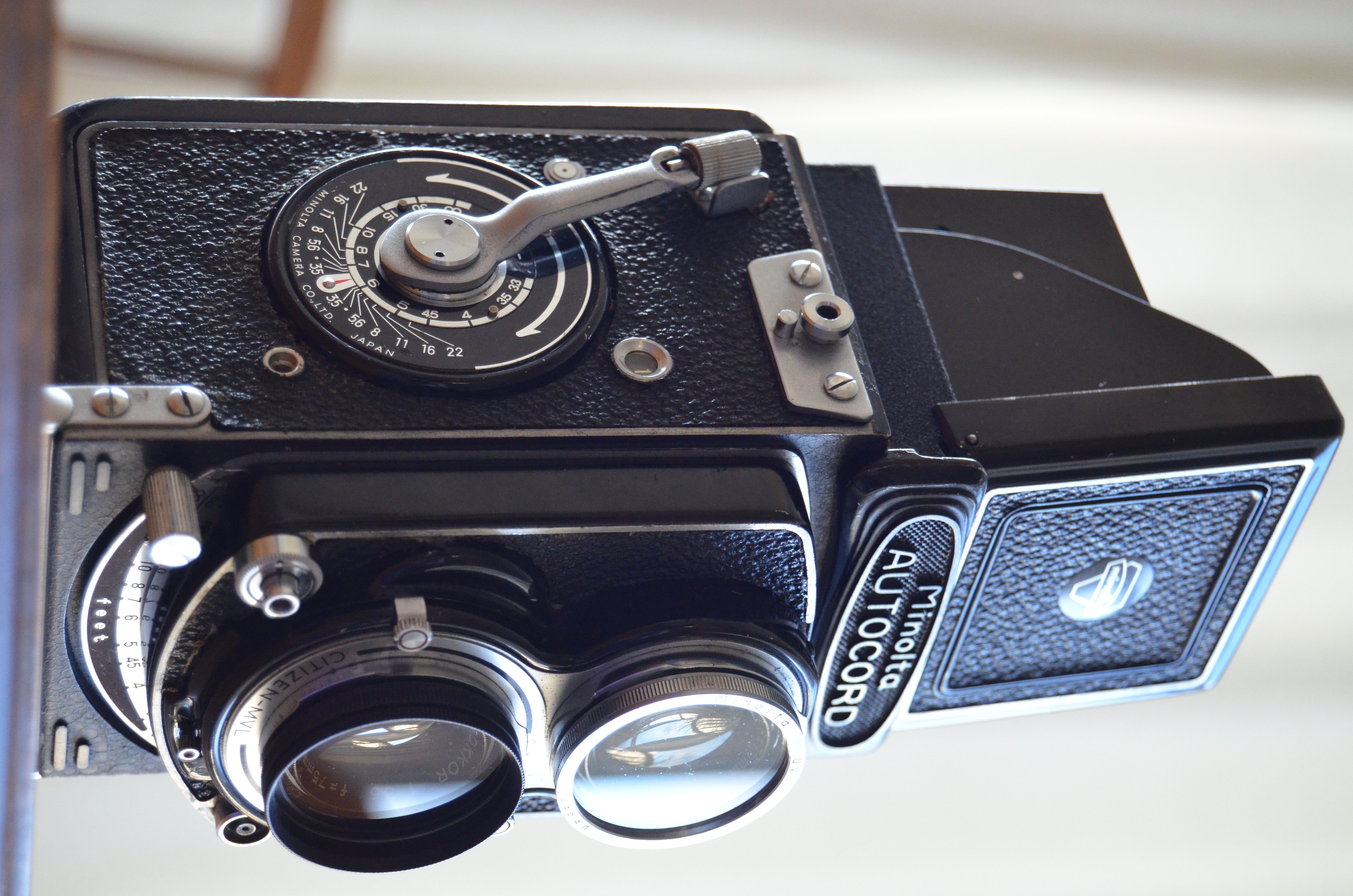
Specifications
| Taking Lens | Rokkor 75mm f/3.5 |
| Viewing Lens | Rokkor 75mm f/3.2 |
| Lens Elements | 4 |
| Shutter | Optiper MXS/MXV |
| Shutter Speeds | 1s - 1/400s + B (early) or 1/500s (later) |
| Light Meter | None |
| Filter Mount | Bay I |
| Focusing | Crank with auto cocking |
- Crank film advance with auto cocking
- Legendary Rokkor optics
- Self-timer
- Multiple variants
History
Minolta, founded in Osaka in 1928, was already building a reputation for exceptional optics when they introduced the Autocord in 1955. The four-element Rokkor lens used the same Tessar-type formula proven in German cameras but refined with Japanese precision. The Autocord became known for delivering sharp, contrasty images that rivaled cameras costing twice as much. Multiple variants were produced over 10 years, each with small refinements.
Notable Photographers
Beloved by amateur photographers and photojournalists who wanted German-quality results at Japanese prices. A favorite of camera collectors for its build quality.
Cultural Significance
Often cited alongside the Yashica-Mat as proof that 1950s Japanese manufacturing could match or exceed German quality standards.
Innovations
- Optiper shutter reliability
- Smooth crank advance mechanism
- Excellent price-to-quality ratio
Collector Notes
The unmetered original Autocord. The Rokkor lens is exceptionally sharp. Many sub-variants exist — all are excellent. Often overlooked in favor of Yashica, making it a value bargain.
Current Market Prices (USD)
| Condition | Price Range |
|---|---|
| Poor | $40 – $80 |
| Average | $80 – $140 |
| Good | $140 – $210 |
| Excellent | $210 – $300 |
| Mint | $300 – $420 |
Source: eBay 2024
Shop for Minolta Autocord on eBay
Articles & Reviews
- Minolta Autocord Film Camera Review — Shoot It With Film
- Minolta Autocord - Medium Format Camera Review — Casual Photophile
- Minolta Autocord TLR: First Impressions — 35mmc
- Lomopedia: Minolta Autocord — Lomography
Manuals & Documentation
Photo Galleries
Shoot with your Minolta Autocord
TLR Companion is a free light meter app and film roll tracker built for TLR and medium format photographers. Meter light, load film, track every frame.
Planning a long exposure? TLR Companion handles ND filter compensation and reciprocity correction for 19 film stocks.