Yashica Mat-124G
The people's Rolleiflex — Japanese quality at a fraction of the price.
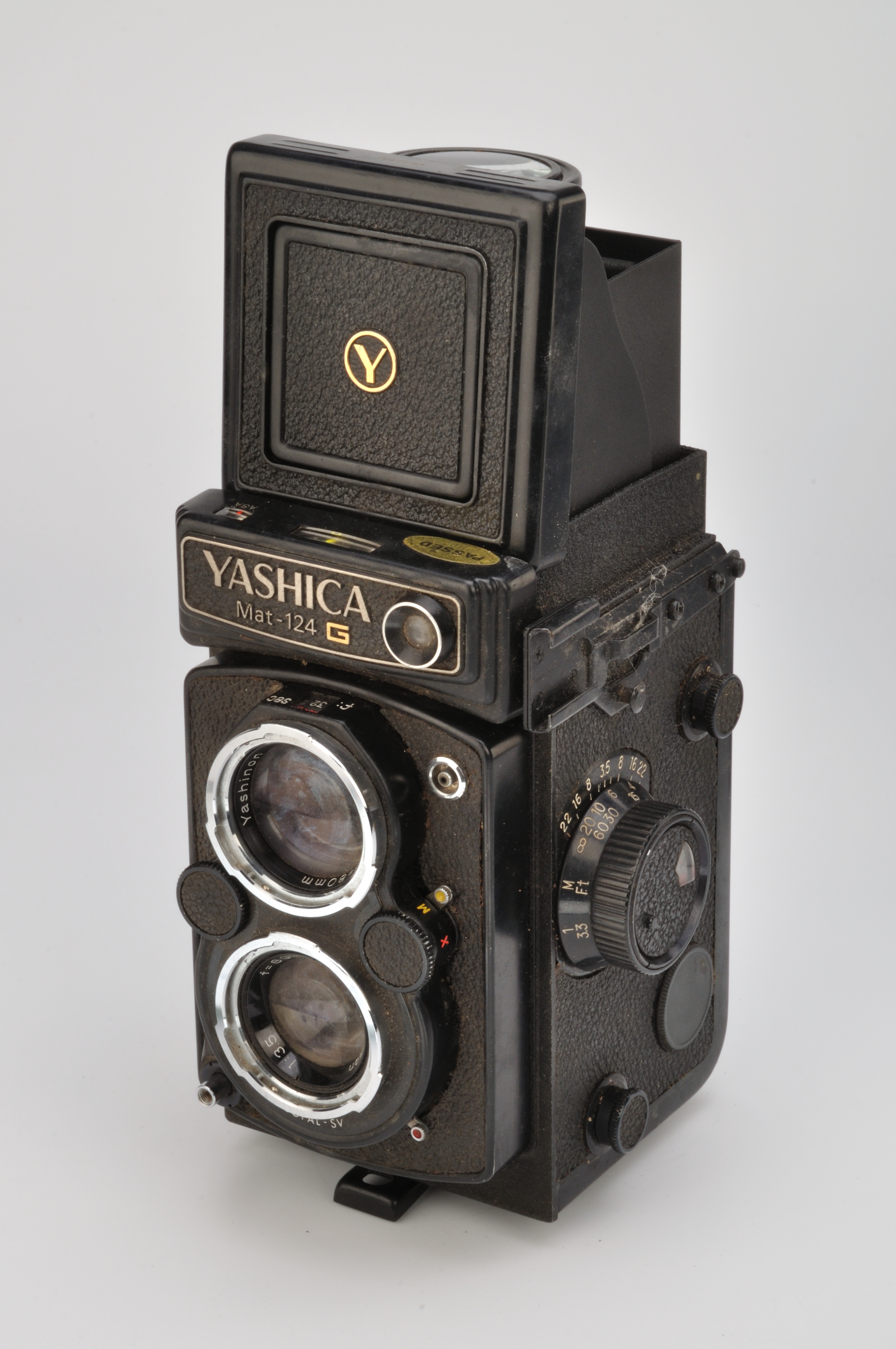
Specifications
| Taking Lens | Yashinon 80mm f/3.5 |
| Viewing Lens | Yashinon 80mm f/2.8 |
| Lens Elements | 4 |
| Shutter | Copal SV |
| Shutter Speeds | 1s - 1/500s + B |
| Light Meter | CdS coupled |
| Filter Mount | Bay I |
| Focusing | Crank with helicoid |
| Weight | 1070g |
- Last Yashica TLR produced
- Gold-plated contacts
- CdS meter with match-needle display
- 120/220 film switching
- 16 years in production
History
Yashima Seiki began in 1949 with just 8 employees making clock parts in Nagano, Japan. By 1953 they produced their first camera. The Mat-124G, introduced in 1970, represents the culmination of nearly two decades of TLR refinement. It sold in enormous quantities and became the most widely used TLR among working professionals who couldn't justify Rolleiflex prices. Its remarkable 16-year production run lasted until 1986, making it both the last and most beloved Yashica TLR.
Notable Photographers
Widely used by wedding photographers, portrait studios, and photojournalists throughout the 1970s and 80s who needed medium format quality without Rolleiflex prices.
Cultural Significance
Often called 'the poor man's Rolleiflex,' though this undersells its excellent Yashinon optics. Featured in countless 'getting into medium format' guides as the ideal starter TLR.
Innovations
- CdS battery-powered meter
- Gold-plated electrical contacts
- 120/220 film switching
Collector Notes
The most sought-after Yashica TLR. At a fraction of Rolleiflex prices, it delivers comparable image quality. Check that the meter still works — many have weak or dead batteries.
Current Market Prices (USD)
| Condition | Price Range |
|---|---|
| Poor | $80 – $120 |
| Average | $160 – $200 |
| Good | $220 – $280 |
| Excellent | $300 – $400 |
| Mint | $380 – $500 |
Source: eBay/Collectiblend 2024
Shop for Yashica Mat-124G on eBay
Articles & Reviews
- Yashica Mat-124G Camera Review — Shoot It With Film
- Yashicamat 124G Review — Kosmo Foto
- Yashica MAT 124G and its auxiliary lenses Review — 35mmc
- Yashica Mat-124G Review — EMULSIVE
Video Tutorials & Reviews
- Yashica Mat-124G Review — One of my favourite medium format cameras — Kyle McDougall
- Yashica Mat 124G Review — A Stunning Camera That Creates Stunning Images — Matthew Arrington
- My First Medium Format Film Roll Through the Yashica Mat 124G — jaycie linh
- Rolleiflex 3.5 Planar vs. Yashica Mat 124G — Which Film Camera Is Better? — Imran Nuri
- Starting With Yashica Mat 124G — The Ultimate Conversational Camera — Ahsan Abbas
- Fix Old Cameras: Yashica Mat 124G Wind Crank — Fix Old Cameras (repair tutorial)
- Loading some Kodak Portra into my Yashica Mat 124G — Hamilton Young Ward
Manuals & Documentation
Photo Galleries
Shoot with your Yashica Mat-124G
TLR Companion is a free light meter app and film roll tracker built for TLR and medium format photographers. Meter light, load film, track every frame.
Planning a long exposure? TLR Companion handles ND filter compensation and reciprocity correction for 19 film stocks.